We turn empty buildings and tired fields into Produce Factories.
A Produce Factory is a commercial-scale food production facility — 108 growing sites per tower, a harvest every 4–6 weeks, on up to 95% less water. Tell us what you have. We will design what it becomes.
What is a Produce Factory?
Three words, and only one of them is a product.
Most people meet us and assume we sell towers. We do not. The tower is a component. What we actually do is turn a site into a facility.
The Tower
A vertical column of 108 growing sites. Roots hang in open air and are misted with nutrient solution. No soil, no tank of its own.
The Pod
One central tank and its dedicated pumps, feeding 16–96 towers on a single nutrient recipe. Pods are how the system scales — and how one site grows more than one crop.
The Produce Factory
Your site, converted. A commercial-scale food production facility that grows the healthiest food in the safest conditions at the highest margin the building can carry.
You do not buy a Produce Factory. Your site becomes one.
The conversion
Same walls. Same square footage. One of them earns.
Nothing gets poured, rezoned or demolished. We survey the site, engineer the layout and supply the system — then your crew builds it against our drawings. It is plumbing and assembly, not a construction project.
The denominator problem
Farming did not stop being profitable. It stopped being divisible.
The cost of an acre goes up every year — land, water, fuel, labour, chemicals, insurance. What an acre yields does not. So the margin gets squeezed from both ends, and the only lever left is to farm more acres, which costs more money, which squeezes the margin again.
That is the trap. And you cannot out-work it, because the problem is not effort. The problem is the denominator.
So change it. Grow up, not out.
And run it all year
A soil crop bets the year on one window. A tower harvests every month.
Hail in the wrong week, a late frost, a dry August — outdoors, one bad fortnight takes the season with it. Inside a controlled loop, a 4–6-week cycle means a bad week costs you a cycle, not a year. Revenue stops being seasonal and starts being scheduled.
What are you converting?
Four sites. Four completely different reasons this pays.
An empty warehouse and a working farm are not buying the same thing. Pick the one you actually have, and we will show you the economics that apply to it.
Industrial & Warehouse
It already has power, water and a roof. It is a farm that has not been told yet.
See the conversion →Greenhouse & CEA
You already control the climate. You are just not using the height.
See the conversion →Working Farmland
You cannot out-acre the industrial farms. You can out-margin them.
See the conversion →Urban & Civic
A food desert is a logistics problem. Solve it with geography.
See the conversion →The machine
Roots in open air. Nutrients as mist. Nothing runs off.
There is no soil to hold the plant back and no reservoir to drown it in. A pump lifts nutrient solution up the centre of the tower, nozzles atomise it directly onto bare roots, and whatever the roots do not take is caught and sent round again.
Oxygen at the root is what makes it fast. Recirculation is what makes it cheap. Removing the soil is what makes it clean — no soil-borne pests means no reason to spray.
The full breakdown →Density
Nutrient-balanced mist reaches every one of the 108 sites in a tower. Faster growth, higher yield, consistent quality — with nothing wasted on the ground.
Central Control
Nutrients are dosed per pod, not per tower. One tank and its pumps serve up to ninety-six towers, so you manage a handful of control points instead of hundreds. No tilling, no rotation, no machinery.
Monitoring
Nutrient levels, humidity, temperature and root health tracked in real time. A constant feedback loop that catches a fluctuation before it becomes a lost cycle.
Support
System training, proactive maintenance insight and expert guidance from a team that manufactures the hardware it supports.
The pod
Nutrients are dosed centrally — per pod, not per tower.
One tank. Its own dedicated pumps. A feed manifold out, a return line back, and anywhere from 16 to 96 towers hanging off it — 96 is the ceiling we recommend on a single tank. The towers themselves hold no tank at all.
And here is why that matters
Every pod carries its own recipe. So one field grows more than one crop.
Because each pod is dosed independently, the nutrient profile in one section of the field has nothing to do with the section beside it. Strawberries on one recipe. Lettuce on another. Kale on a third. Same site, same day, same crew.
A single-crop farm lives and dies on one price. A facility running four recipes hedges across four markets — and can chase whichever one is paying this quarter without touching the rest of the field.
Stop being a single-crop supplier.
In the ground, not in a render
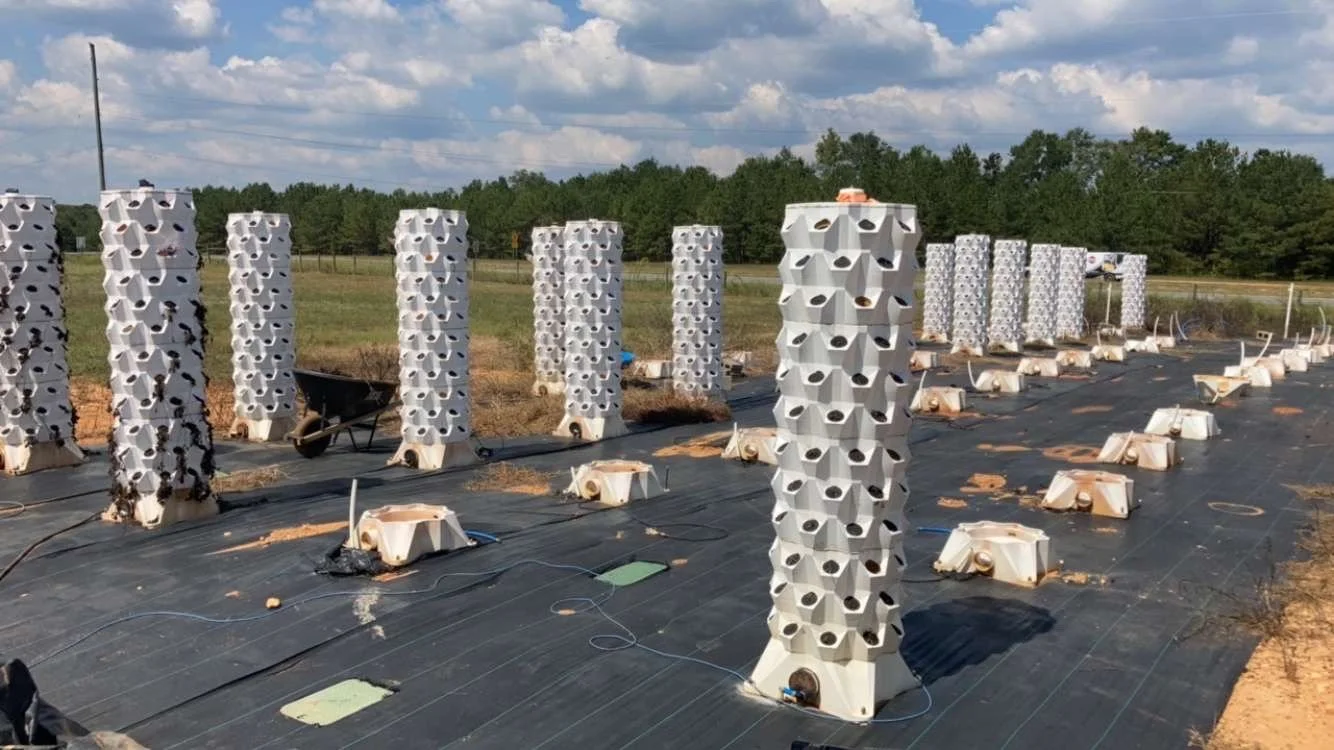
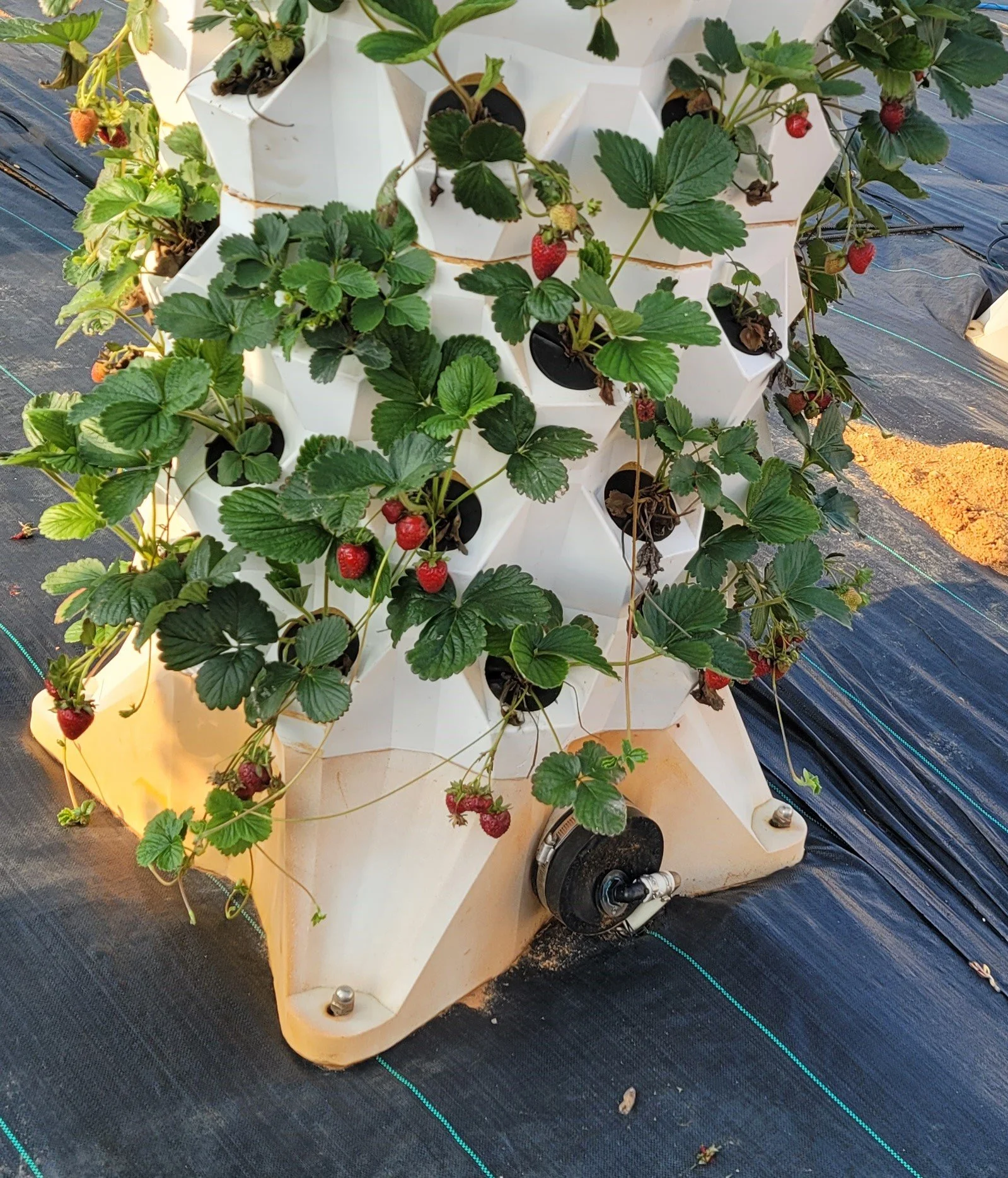
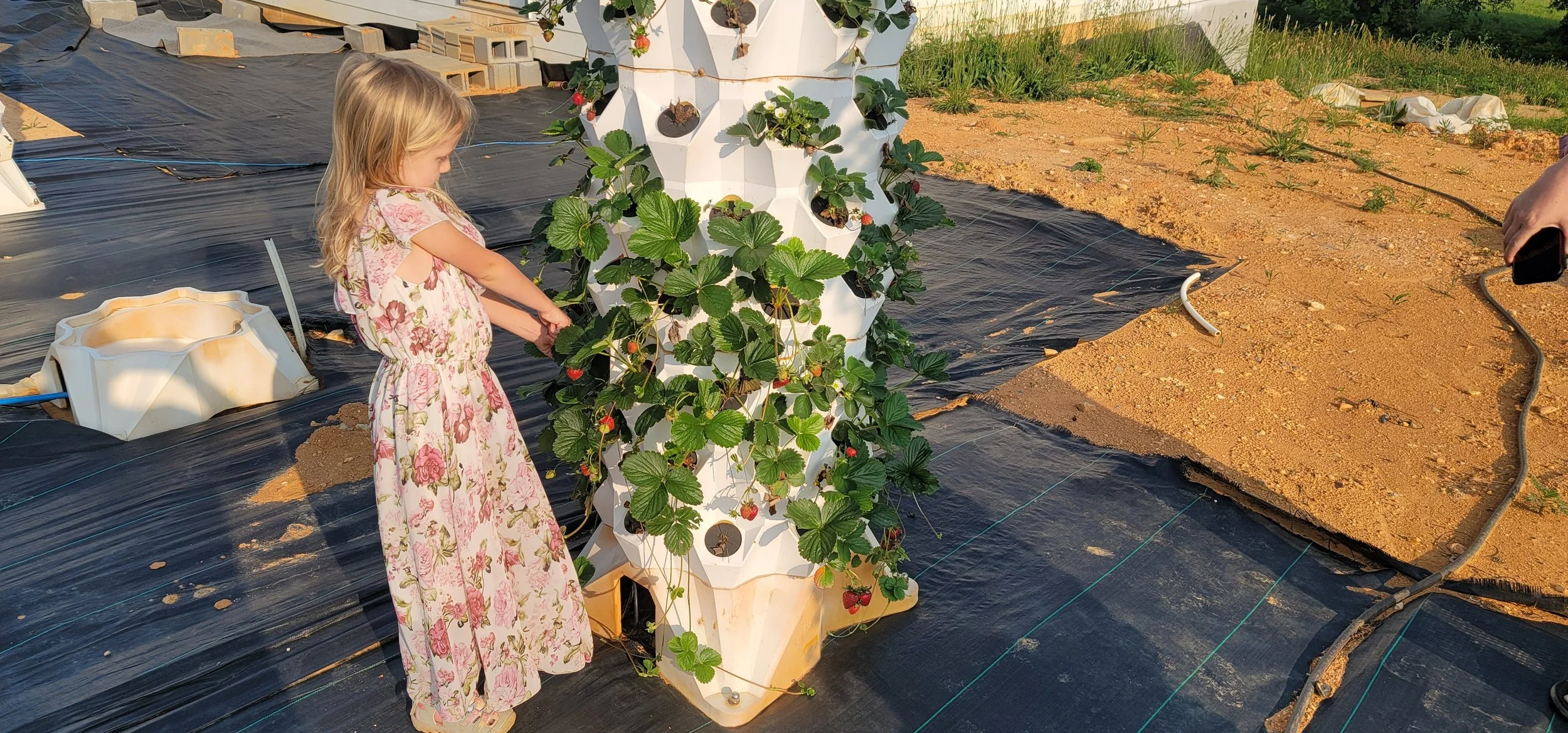
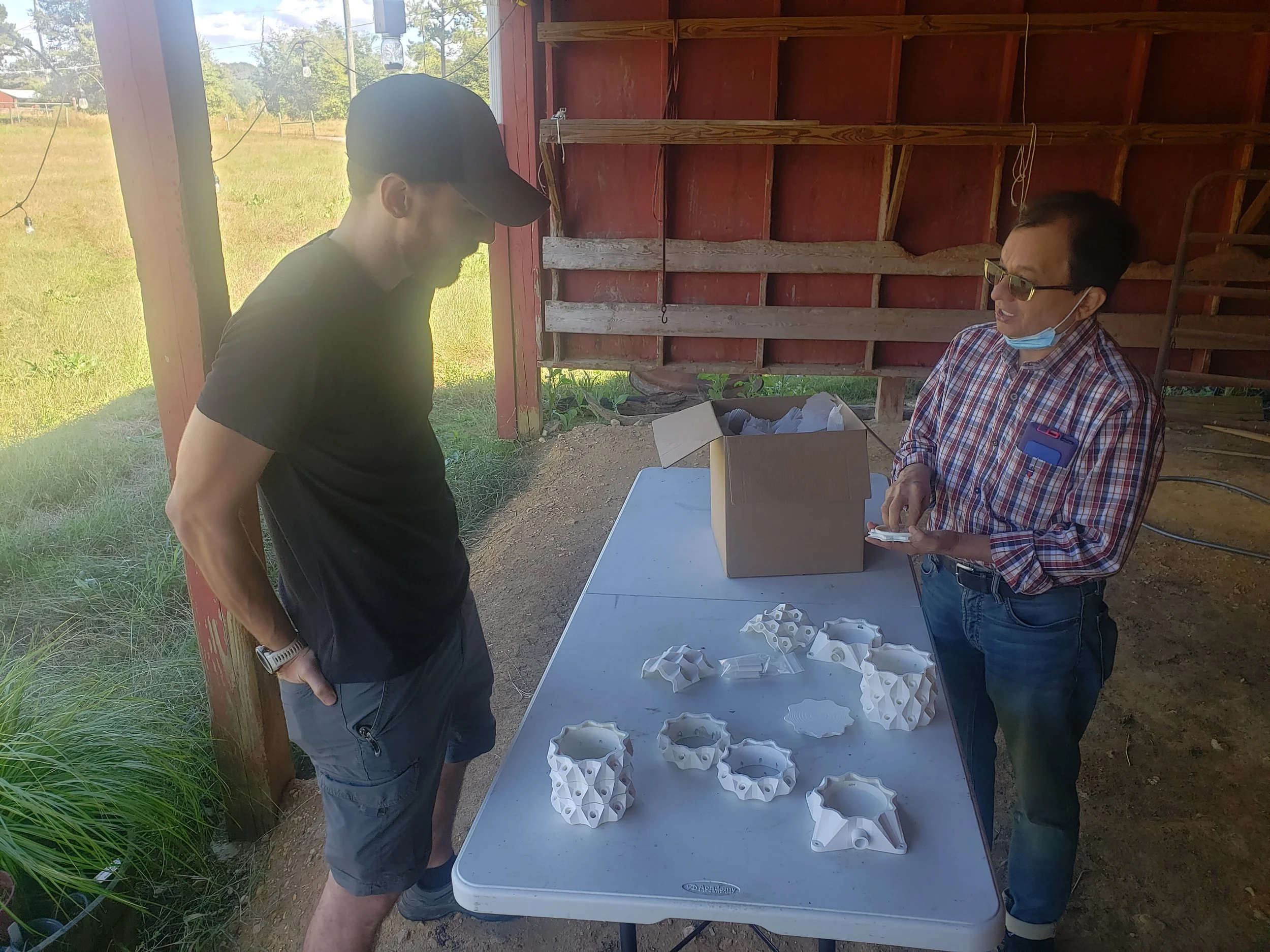
This is a photograph, not an artist's impression.
Most vertical farming companies will sell you a beautiful rendering of a facility that does not exist. These are our towers, in a field, with fruit on them.
What to grow
Pick the crop by its margin, not its novelty.
The system will grow a great many things. These four are the ones that reliably pay for the tower they are standing in.
Highest marginStrawberries
The premium crop the towers were built to prove.
Why it sells → Fastest cycle
Lettuce
The workhorse. Fastest turn, steadiest demand.
Why it sells → Clean-label premium
Kale
A superfood that pays a premium for being clean.
Why it sells → Cut-and-come-again
Spinach
Harvest the same plant more than once.
Why it sells →Made in America
A machine you can get parts for.
The towers are engineered and manufactured in the United States. That is not a flag to wave — it is a lead time, a spare part that arrives, and an engineer who answers the phone.
Every ProduceFactory is also an anchor where it stands: it grows food locally and keeps the operating profit in that community, instead of handing it to the chain of trucks, packers and warehouses that moves produce across a continent before anyone eats it.
Read the manufacturing story →
Find out what your square footage is actually worth.
A 30-minute grower consult. Bring your site, your crop and your buyers — we will tell you what it becomes as a Produce Factory, and whether the numbers work.